
The Nervous System, Safety and the Biology of Calm

Where science meets soul, wellbeing begins with trust. Notes from the Apothecary in Residence Jane Connor.
One of the questions I return to again and again is remarkably simple.
What allows the human body to heal?
The answer is rarely found in one treatment, one medicine or one intervention.
Healing is a conversation taking place throughout the body.
Every second, our nervous system is interpreting the world around us. It is constantly asking one fundamental question:
Am I safe?
We often think of safety as something physical.
But biology tells us it is much more than that.
Safety can be influenced by the people around us, the environment we are in, the quality of our sleep, our relationships, pain, stress, previous experiences, and even familiar sounds and scents.
Our nervous system is continually gathering information and adjusting our physiology accordingly.
The Physiology of Calm
When we experience prolonged stress, the sympathetic nervous system helps us prepare for challenge.
Heart rate increases.
Breathing becomes quicker.
Blood pressure may rise.
Stress hormones such as cortisol and adrenaline are released.
These responses are not harmful in themselves.
They are essential for survival.
The difficulty comes when the body struggles to return to a quieter, more restorative state.
This is where the parasympathetic nervous system becomes so important.
Often referred to as our "rest and digest" system, it supports slowing the heart, easing breathing, encouraging digestion, supporting sleep and creating the conditions in which repair and recovery can take place.
Calm is not the opposite of health.
Calm is one of the body's ways of supporting health.
Creating Conditions Rather Than Promising Outcomes
This way of thinking has gradually become one of the guiding principles of The Living Apothecary.
Rather than asking,
"How do we fix this?"
I increasingly find myself asking,
"What conditions might help this person feel safer, calmer and better supported?"
Sometimes that may include therapeutic touch.
Sometimes gentle movement.
Sometimes time in nature.
Sometimes conversation.
Sometimes rest.
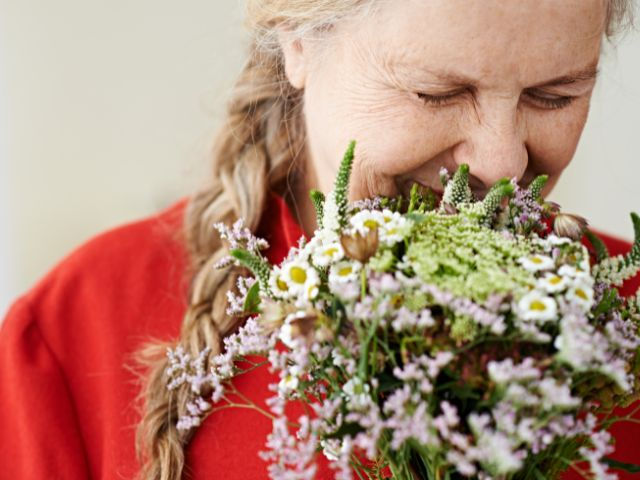
Sometimes the familiar scent of lavender or German chamomile.
None of these should be viewed as cures.
Yet each may become part of a wider environment that allows the body to move towards balance.
Where Aromatherapy Sits
Modern research continues to explore how scent influences the brain and nervous system.
Unlike many of our senses, smell has direct connections with areas involved in memory, emotion and emotional processing.
This may help explain why certain aromas can evoke powerful feelings of comfort, familiarity or calm.
Researchers are now investigating whether these responses may also influence measurable physiological outcomes such as anxiety, heart rate, sleep quality and blood pressure.
While many questions remain unanswered, the research is encouraging enough to continue asking thoughtful questions.
A Living Practice
Perhaps this is what I enjoy most about working within The Living Apothecary.
Not searching for certainty.
But remaining curious.
Reading the science.
Listening to the stories people bring into clinic.
Watching the seasons change in the garden.
Allowing each to inform the other.
Healing is rarely one dramatic event.
More often, it is the accumulation of many small moments that gently move us towards wellbeing.
A good night's sleep.
A nourishing meal.
A quiet walk.
A kind conversation.
The scent of a familiar flower.
None is remarkable on its own.
Together, they create something rather extraordinary.
Perhaps that is where healing begins.
Not with certainty.
But with conditions that allow the body to remember what it has always known how to do.
References
Porges SW. The Polyvagal Theory.
McEwen BS. Research on stress, allostasis and allostatic load.
Frontiers in Medicine. (2026). Effects of aromatherapy on objective physiological outcomes in adult intensive care patients: A systematic review.
Antonovsky A. Health, Stress and Coping.
Huber M et al. How should we define health? BMJ.


Comments